The £20,000-a-Metre Path to Nowhere
Tax and spend - the taxpayer be damned.
By The Wobbly Editor, 15 March 2026
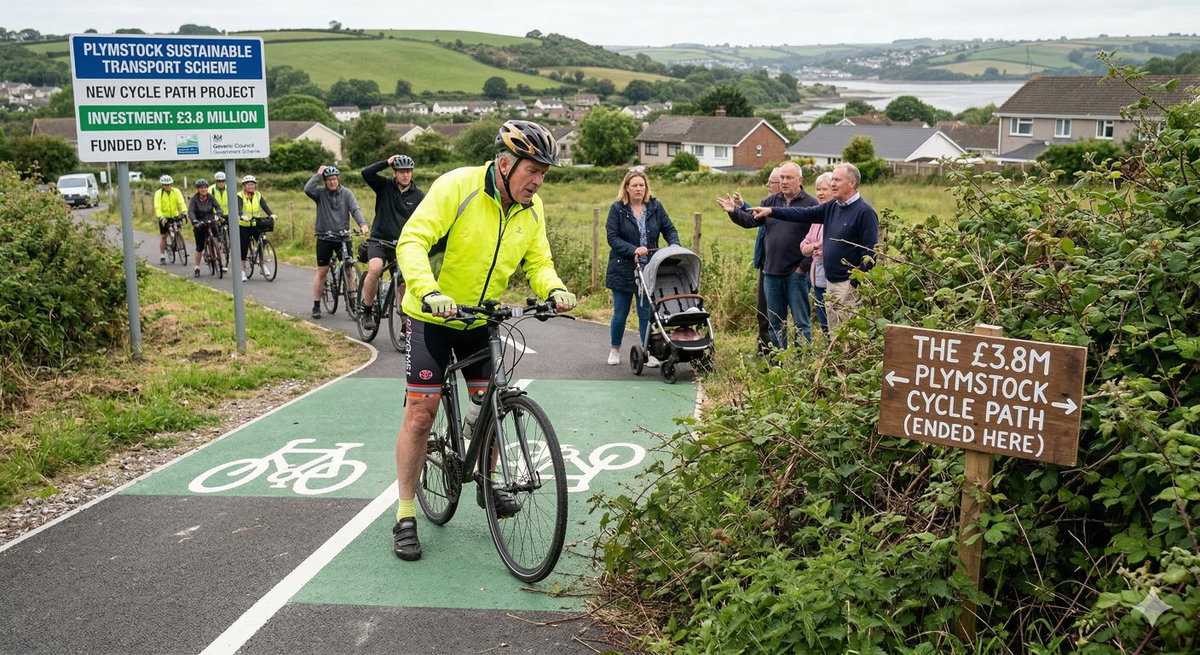
Only a Labour administration would equate £3.8 million on 197 metres of tarmac with value for tax-payer money. It’s a feat of financial alchemy that even the most profligate of governments would struggle to replicate. Yet in Plymstock, a suburb of Plymouth, the local Labour-run council has achieved the seemingly impossible. It’s building a cycle path at a cost of nearly £20,000 for every single metre. Tax and spend – the taxpayer be damned.
Just pause for a moment to absorb that figure. To reflect on both its magnitude and its absurdity. For the price of a single metre of this path, you could buy a decent second-hand car. For the price of ten metres, you could put down a deposit on a house. For the full £3.8 million, you could fund the annual salaries of more than 100 nurses. Instead, Plymouth City Council is using it to bore through a disused railway tunnel to create a stretch of path that residents predict will be used by a handful of cyclists a day.
The project, which will link two existing cycle routes as part of the new Sherford housing development, is little more than a direct and ongoing assault – or at the very least, the middle finger, to the community the Labour-run authority supposed to serve. To build this 197-metre path, the Council has closed a local road for 14 months, effectively isolating a community and forcing residents into long and costly diversions. One local has calculated the detours will cost him an additional £3,000 in fuel alone. Others have reported health problems exacerbated by the stress and disruption. It’s little wonder that those who live there have branded the scheme “barking mad”, “ludicrous,” and a “total waste of money.”
The Council, of course, defends its grand project with the familiar, soothing jargon of the urban planner. This, we are told, is not just a cycle path. It’s a “high quality, step free and traffic free walking and cycling route” that will be “accessible, attractive” and cater to everyone from cyclists to mobility scooter users. It is part of a grand vision for “active travel”, funded by grants from central government and contributions from housing developers.
But the heart of the matter is this: The money for this scheme comes from a dedicated pot of “active travel” funding. It is, in effect, “use it or lose it” money. And so, the incentive for the Council is not to find the most cost-effective solution to a real problem, but to find a project, any project, that is sufficiently ambitious to justify spending the grant money. The act of spending becomes the goal in itself.
No sane person, if given £3.8 million to improve transport in Plymstock, would have chosen to spend it this way. They would have filled potholes, improved bus services, or perhaps even explored less disruptive ways to connect the existing cycle paths. But the logic of government grants warps all sensible priorities. It creates a situation where a £20,000-a-metre cycle path that requires 14 months of disruption can be presented with a straight face as a public good.
The residents of Plymstock are not anti-cycling. They are anti-waste. They are anti-disruption. They are anti-bureaucratic folly. They can see what the Council, blinded by the lure of “free” government money, cannot: that this project is a monument to misplaced priorities and a staggering dereliction of fiscal responsibility.
When the path is finally finished in April of next year, the Councillors will no doubt gather for a celebratory photo-op. They will praise their own vision and their commitment to a greener future. But it’s the taxpayer that will be left with the bill - not just the financial cost, but the cost of 14 months of their lives being turned upside down for a path to nowhere that nobody asked for.