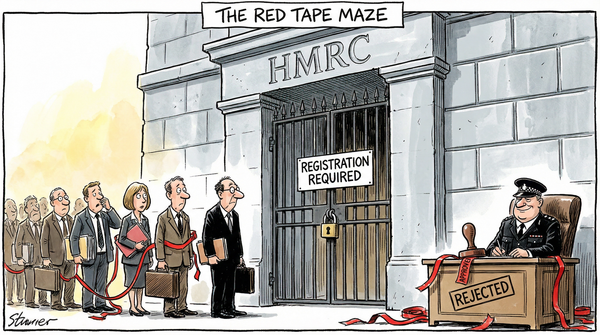
The Exit Trap: Why the South West’s ‘Succession Crisis’ is a Tax on Toil
As retiring founders head towards the ‘Exit’ sign, the Treasury has quietly padlocked the door. We explore why the South West’s brewing succession crisis is being treated as a revenue stream.

17 January 2026
From the aerospace hangars of Filton to the engineering sheds of Yeovil, a quiet but frantic race is underway: not for new orders or technological breakthroughs, but for the door.
For forty years, the region’s industrial spine has been held together by a generation of founders who understood that "wealth" is something that you build with grit and machine oil, not something you "capture" on a pitch deck. Now, as this cohort reaches for the exit, they’re finding that the Treasury has quietly padlocked the gates.
According to reports released earlier this month, nearly two in five South West manufacturers expect to lead a sell-side deal in the next twelve months. It’s a demographic that finds itself meeting a fiscal ambush – recent changes made by the Treasury mean the reward for a lifetime of toil is now a precarious legal dice-roll against a ticking clock.
The November Ambush
Until recently, the Employee Ownership Trust (EOT) was the Goldilocks exit for the family firm - a way to preserve the company’s DNA while allowing the founder to walk away with a 100 per cent Capital Gains Tax relief. Sadly, this was far too civilised for the current administration, whose mantra seems to be: if you’ve built it, or saved it, we will tax it.
The November 2025 Budget changed the equation overnight, slashing that relief in half and effectively imposing a 12 per cent "exit fee" on what was previously a tax-free transition. Framing this measure (which, let’s face it, is just another means of picking the pockets of the country’s doers) as a “crackdown on tax avoidance," the Treasury has managed to penalise the very stability that it claims to champion. For the Gloucestershire engineer or the Somerset fabricator, the message from Whitehall is clear: your legacy is no longer an asset to be preserved, rather a revenue stream to be milked.
The Rise of the ‘Dark Art’ MBO
With the EOT route compromised by this new exit fee, the Management Buyout (MBO) has returned as a weapon of choice. Yet an MBO is not a simple transaction: it involves teams of bankers and lawyers, requiring a level of legal, financial, and commercial "heavy weaponry" that many regional boards just haven't needed until now.
Why the sudden need for such sophistication? For a generation, the South West family firm thrived on continuity and the occasional "friendly" EOT. In such gentler climes, a firm’s legacy could be passed on with a handshake and a standard-issue trust deed. The boardroom climate of 2026 has turned distinctly colder, however. Between the Provision 29 Corporate Governance Code declarations now required in the boardroom - turning internal oversight into a personal liability trap - and the new £2.5m cap on Business Property Relief that once again treats businesses as a tax-raid opportunity rather than a regional asset, once minor (or at least hidden) risks have developed a voice. When you also add Labour’s new 'Day-One' employment liabilities, what was once a simple transition has now become a trial.
The April 2026 Ticking Clock
The true "Exit Trap" however, arrives on 6 April. This is when the tax rate on Business Asset Disposal Relief - the artist formerly known as Entrepreneurs' Relief - jumps from 14 per cent to 18 per cent.
On a £10 million sale, that four per cent hike represents an additional £400,000 "success tax" extracted directly from the retirement fund of a local employer. When added to the recent blizzard of costs dropped on those actually creating, grafting and doing in our region - higher Employers' NICs, the increased minimum wage, expanded day-one employment rights – one has to ask - there been a more anti-business climate in recent memory? You need to go back to the stagflation and industrial policies of the 1970s to find such an egregious disregard for our engines of growth.
(Of course, one group is doing remarkably well: every corporate lawyer and accountant from Bristol to Cheltenham is currently buried under a mountain of "urgent" restructuring as founders scramble to complete their distributions before the clock strikes twelve on the current tax year.)
The Mirage of ‘Support’
The Government talks in one breath about supporting the "productive middle". Yet it then bludgeons those soft words to death with an "Industrial Strategy" (shudder) that views exits not as generational-wealth-transitions to be encouraged, but as new sources of income for a Treasury desperate to placate its back benchers.
When a family firm in Gloucester or a tech start-up in Bristol is forced into a sale because the tax hurdles have become too high, the whole region loses. The "capital" that built these firms is being treated as "cash" to be raided, ignoring the fact that once a local business is gone, it's gone, as is the sponsorship of the local cricket club, or the apprenticeship for the lad down the road - they vanish forever. Worse still, the incentive to bother is replaced by an indolence that rapidly contaminates the next generation.
This isn’t the "mission growth" the Government continues to trumpet - it’s the systematic padding of the Treasury’s coffers at the expense of regional resilience. If you’re a founder currently eyeing the "Exit" sign, the lesson of 2026 is simple: don’t wait for the government to move the goalposts again.
Stay Wobbly. Have one for the road (but none for the Treasury).