The Gloucester Gambit: A Study in the 'Edifice Complex' and the Bankrupting of a City
Is Gloucester building a future, or merely a very expensive tombstone for its finances? Exploring the '10-mile duplicity' of the Kings Quarter and why the city’s latest regeneration project may just be a masterclass in municipal vanity.
By The Wobbly Editor
January 10, 2026
There’s an old adage in finance: if you owe the bank a thousand quid, you have a problem. If you owe the bank a million quid, the bank has a problem. In Gloucester, the local council appears to have taken this logic and applied it to their budget with zeal.
Gloucester City Council finds itself in a state of fiscal schizophrenia. On one hand, it has approached Whitehall with a metaphorical tin cup, requesting £17.5 million in "Exceptional Financial Support" to avoid the ignominy of a Section 114 notice - the local government equivalent of bankruptcy. On the other, it's finalising its £107 million regeneration project, The Forum, while voting to lend a further £4 million in commercial funds to underwrite the pre-opening costs of a global hotel chain.
It's a tale of two cities: one where public library hours are slashed and the historic 13th-century Blackfriars Priory faces a precarious future, and another where the Council acts as a swashbuckling venture capitalist, betting the house on a vision of "Digital Gloucester" that may be nothing more than a mirage.
The Allure of the 'Digital Heart'
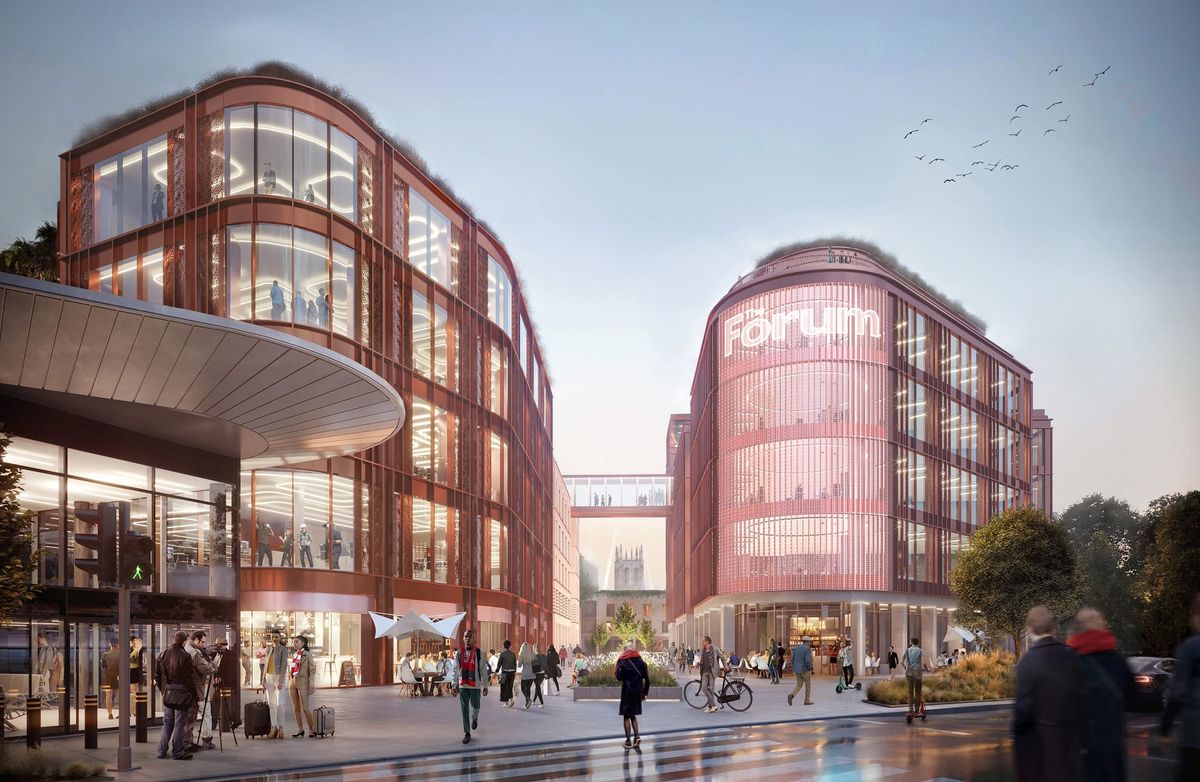
To be fair to the Council’s leadership, the "vanity project" label can be thrown around too easily. The Forum is not a meaningless monument: it’s a genuine attempt to pivot Gloucester away from its fading retail past toward a high-tech future. Located in the Kings Quarter, the development aims to provide 142,000 square feet of "Grade A" office space and a boutique hotel.
And make no mistake, that pitch is very seductive (as is the building itself - it's genuinely great architecture). For decades, Gloucester has watched as its more affluent neighbour, Cheltenham, hoovered up the swankier services and investment. The Forum was designed to change the narrative - to create a "digital heart" that would lure the high growth start-ups of the South West to the city centre. And when the cranes first arrived, the project was indeed popular, locals having long grown tired of the eyesore that had blighted the city for a generation.
But popularity in the planning phase is a poor substitute for solvency in the delivery phase. The question for 2026 is no longer whether The Forum looks good in a brochure, but whether the city can actually afford it.
The Venture Capitalist Council
The most striking element of Gloucester’s gambit is the Council’s transformation into a commercial lender. The vote this week to provide a £4 million mobilisation loan to the InterContinental Hotels Group for a boutique ‘Hotel Indigo’ is a move of breath taking audacity.
Providing "initial working capital" to one of the largest hotel conglomerates on the planet is not usually the remit of a local authority, particularly one that is pleading poverty to the Treasury: it's certainly a radical departure from the statutory duties of a local authority - merchant banking masquerading as municipal governance. The Council argues that this is a "secured commercial loan" that will generate a return. In an ideal world, they are right. And in an even more ideal world, their lawyers will have stress-tested the cojones of the entity giving that guarantee. But one can’t help but notice that in a world of rising interest rates, they’re acting as a lender of last resort, for a project they are too deep into to now let fail. That just doesn’t feel like an investment decision that’s been made with a clear head.
The Shadow of the Golden Valley
Perhaps the saddest part of Gloucester’s "Digital Heart" is that it is being built in the long shadow of a much larger, more coherent beast. Just ten miles up the A40, the Golden Valley Development in Cheltenham has this week moved into its final planning stages. While Gloucester is acting as a sub-prime lender for a city-centre hotel, Cheltenham is breaking ground on a £1 billion innovation district backed by the weight of GCHQ and the government’s own National Cyber Strategy.
One has to wonder if the planners in Gloucester have looked at the map. In a region short on "Grade A" tenants, we’re witnessing a municipal arms race, underwritten by the local tax payer. Gloucester is attempting to lure tech firms into a city centre with the equivalent of a digital Blue Peter badge. It’s not hard to envisage though, that global talent will ultimately gravitate toward the "IDEA" building - the 160,000 sq. ft. National Cyber Innovation Centre, in Cheltenham.
It's a classic case of duplication over collaboration. Gloucester Council is either gambling that Gloucester will somehow out-tech the "Cyber Capital" of the UK, or it's turning a blind eye to what may rapidly become yet another white elephant.
The Human Cost of 'Grade A' Ambition
While Gloucester Council obsesses over the "digital finish" of its glass towers, the traditional soul of the city is being hollowed out. The news that the Council may end its lease on Blackfriars Priory - one of the finest examples of a Dominican friary in the country - is a stinging blow. It’s an admission that the "New Gloucester" has no room (or budget) for the "Old Gloucester".
There is a grim irony in a strategy that seeks to attract "high-value individuals" to a city centre while simultaneously cutting the cultural and historic assets that make a city worth living in. A "Digital Hub" is merely a collection of desks if the surrounding city is a desert of shuttered libraries and neglected heritage.
Vanity vs. Vision
Is The Forum a vanity project? If we define a vanity project as something built to satisfy the ego of a leader rather than the needs of the led, then Gloucester is walking a very thin line.
A project becomes "vanity" when its primary purpose is to change a "reputation" rather than solve a "reality." The reality for Gloucester is that its private sector - its SMEs in particular, needs a council that does the basics well. It needs competitive (read, ‘low’) business rates, efficient services, and a stable fiscal environment. Instead, the Council has prioritised a high-stakes commercial development that has required a £17.5 million bailout to sustain.
Digital dreams are all well and good, but when the bailiffs are at the door, they count for little.
Stay Wobbly. Trust the pavement, not the plan.