The Industrialisation of the Countryside: The Case Against Large-Scale Solar
By The Wobbly Editor, 6 February 2026
The English countryside is often seen in one of two ways. Either as bucolic rolling hills, with Blake’s 'Jerusalem' as its soundtrack, or as a landscape filled with livestock or crops that feed the Nation. Whatever your perception, it serves as both a generator of tourism, and as the engine room of our agricultural sector.
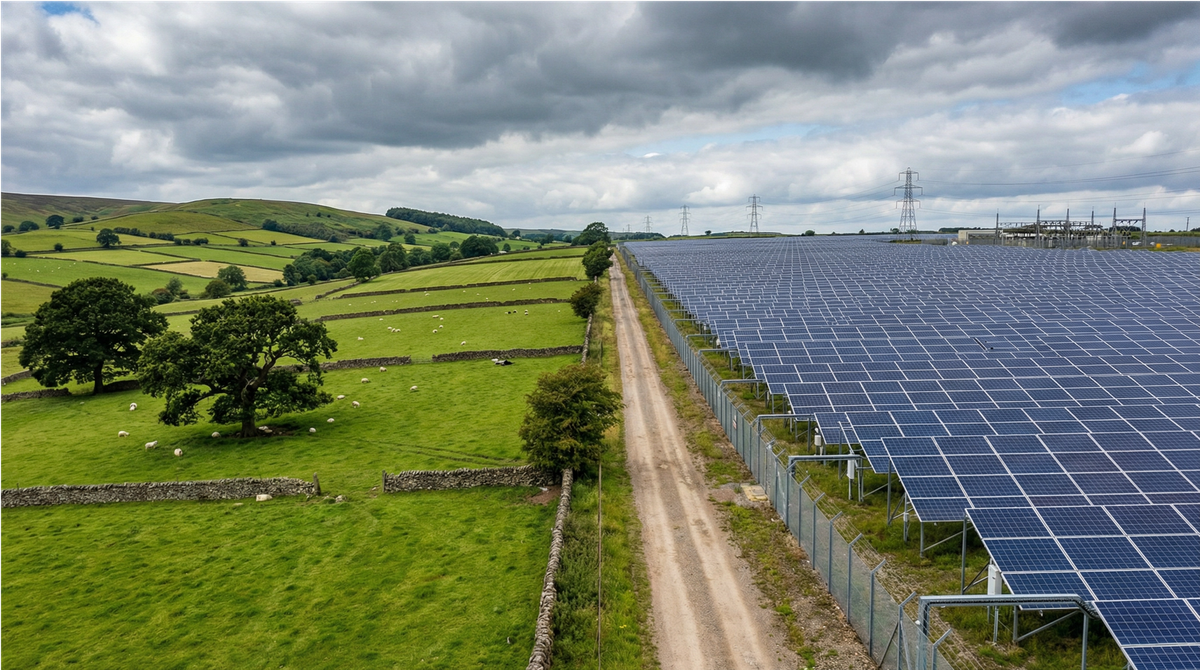
Earlier this week though, the Government approved subsidies for 157 new solar farms, covering an area of farmland nearly the size of Manchester. This is not a policy of careful, strategic planning, rather the latest salvo in Ed Miliband’s fanatical net-zero crusade - a form of industrialisation that is being inflicted on our countryside - a land grab that sees our most attractive and productive farmland sacrificed for vast, inefficient, environmentally and economically questionable solar installations.
The Environmental Fallacy
The environmental case for carpeting farmland with solar panels is absurdly weak. The construction process, involving extensive piling, inflicts significant and lasting damage on soil structure. Studies indicate that the organic carbon essential for fertility can decline by nearly 10% under panels, while the particulate organic matter that underpins a healthy soil ecosystem can fall by over 20%. By blocking sunlight and altering drainage, these installations disrupt the natural cycles that make the land productive in the first place.
Furthermore, the promised biodiversity benefits are simply fantasy. Instead of the wildflower meadows filled with the cast of Watership Down touted by developers, the reality is frequently a sterile landscape of gravel or shade-tolerant weeds. The security fencing required for these sites fragments the landscape, severing wildlife corridors and creating impassable barriers for local fauna. This is neither environmentally friendly, nor an enhancement of the local environment – it’s the imposition of an ugly industrial grid onto a living ecosystem.
The manufacture of these panels involves hazardous materials, and the mining of their core components causes significant environmental damage abroad. This is before their transportation back to the UK, often from as far away as China, on diesel-burning cargo ships. It’s an absolute fallacy that these sites are environmentally friendly in any way– all the UK is achieving is the temporary ‘offshoring’ of its carbon footprint – so much for “One Planet”. And the environmental cost extends to the lifecycle of the panels themselves. With a lifespan of around 25 years, Red-Ed is creating a significant future waste problem with no clear, scalable recycling solution in place.
A Direct Threat to National Food Security
In an increasingly unstable world, the ability to feed our own population is a core component of national security. The Government’s policy on solar farms actively undermines this.
An estimated 60% of solar developments in the UK are sited on “Best and Most Versatile” agricultural land. When thousands of acres of high-grade soil are covered with silicon panels, that land is effectively decommissioned. It cannot simply be returned to high-yield production after decades of soil compaction and potential chemical leaching from the panel infrastructure.
Every acre lost to solar development is an acre that no longer contributes to our domestic food supply. This increases our dependence on imported food (again, brought-in either by planes or cargo ships burning fossil fuels), extending our carbon footprint through global supply chains and exposing us to international market volatility. To argue that these installations enhance our security while simultaneously degrading our food sovereignty is at best, a contradiction. At worst, its more gaslighting of the electorate.
The Economic Vandalism of a Landscape-Based Economy
For much of the South West, the primary economic driver is the landscape itself. The region’s beauty underpins a multi-billion-pound tourism industry that supports countless local pubs, shops, and accommodation providers. People don't travel to see miles of security fencing and the glint of glass panels.
The sheer scale of proposed solar projects represents a new level of visual vandalism. From the rolling hills of the Cotswolds to the coastal landscapes of Cornwall, these installations do not blend into the landscape - they dominate it. They industrialise it. They eviscerate it. They shatter the rural character that is the region’s core economic asset. In Wiltshire, the proposed Lime Down Solar Farm would cover over 3,000 acres, drawing nearly 5,000 public objections. In Gloucestershire, a 50MW solar farm on the banks of the River Severn was only recently rejected by the local council, while in Somerset, multiple proposals on the Levels threaten to transform the area into an industrial park.
Research on the impact of industrial energy projects on rural tourism indicates a clear displacement effect. Once a region’s character is compromised, it loses its premium appeal. By turning agricultural valleys into solar parks, the Government is signalling that the region’s primary economic product - its unspoilt landscape - is of negligible value.
A Failure of Joined-Up Thinking
The root of the problem lies in a planning system that prioritises ease of grid connection over the intrinsic value of the land. It’s simply cheaper and easier for developers to build on flat, open farmland than on the millions of square meters of south-facing commercial roof space in our towns and cities.
This is a catastrophic policy failure. We are industrialising the countryside to avoid the logistical challenge of installing panels where the energy is actually consumed. The Government is incentivising the path of least resistance, and the price is being paid by our farmers, our food security, and our rural economy.
What Price a Rational Government Policy?
This is not an argument against renewable energy. It’s an argument for a rational, strategic approach that protects our most valuable agricultural land. True environmentalism requires policies that value soil health, secure our food supply, and respect the economic and cultural importance of our rural landscapes.
The policy should be simple: panels on roofs, not on fields. We must cease treating our countryside as a convenient dumping ground for industrial infrastructure and recognise it as the irreplaceable national asset it is.
Roofs, not fields. Enough of the Greenwashing. Stay Wobbly.