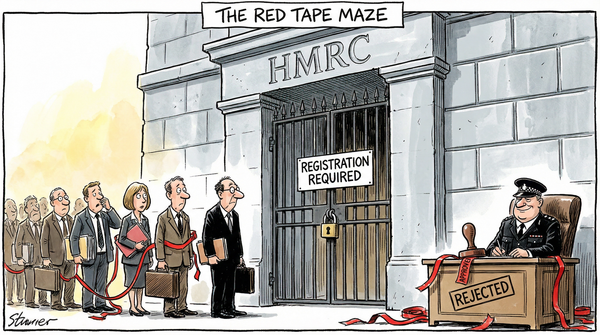
The Six-Month Squeeze: Why Whitehall’s 'Make Work Pay' Gimmick is a Pox on the South West
In Starmer’s Brave New World, if you haven't got their KPIs and your disciplinary paper-trail in order by the time the new recruit has found the office kettle, you are already halfway to an Employment Tribunal. This isn’t an HR change, it’s a hiring handbrake.

By The Wobbly Editor
31 December 2025
There is a particular kind of seasonal madness that descends upon the desk-wallas of Whitehall during the festive period. While the rest of us were engaged in the noble, multi-generational struggle of trying to fit a twenty-pound turkey into a ten-pound oven (and now, a 40-inch waist into a 38-inch trousers), the King was being handed a pen. On the 18th of December, the Employment Rights Act 2025 received Royal Assent.
It is being hailed by the usual suspects (the professional moaners, and just about every Labour MP and their recently appointed social media manager (more about their industrial levels of gaslighting of the electorate another time) as a victory for the "common man." The reality is, it is a staggering, multi-billion pound day-one-hangover for every entrepreneur from Painswick to Penzance.
The Death of the 'Suck-it-and-See' Era
For decades, the "Two-Year Rule" for unfair dismissal served as a vital, common-sense buffer. It was accepted game that employees needed time to get their feet under the table – well, quid pro quo, Clarice – so did the employer. It allowed a founder to take a punt on a brilliant-but-shambolic engineer or a charismatic-but-lazy salesman, safe in the knowledge that if they turned out to be a total dud, they could be sent packing without a phalanx of employment lawyers descending upon the office.
That buffer has been vaporised. Gone are the days of ‘Suck-it-and-See’ ere. We are now entering the era of the ‘Six-Month Squeeze’. By slashing the qualifying period for unfair dismissal from two years to just six months, our Government has essentially nationalised the hiring risk of every SME in the country.
April 2026: The "Day One" Dash
A first wave of this regulatory "help" will arrive in April 2026, when a set of insidious day-one-rights kick in. From their very first hour on the job, your new recruit will be entitled to statutory sick pay, paternity leave and parental leave.
In the old world, you had time to see if a worker actually intended to do some work before you became their health insurer.
In Starmer’s Brave New World, if you haven't got their KPIs and your disciplinary paper-trail in order by the time the new recruit has found the office kettle, you are already halfway to an Employment Tribunal. This isn’t an HR change, it’s a hiring handbrake.
The Great South West: A Tier-1 Identity Crisis
The timing is particularly exquisite. And by exquisite, I mean disastrous. Only this month, the Great South West High Growth Tracker informed us that 100 regional firms are now aligned with the UK's future prosperity, including those involved in clean energy, defence, advanced manufacturing, digital, and food production.
It’s a heartening thought, isn't it? Our region - the land of cider, surf, and the occasional escaped wallaby, is now apparently the "Industrial Engine of Britain" (with no apologies given to any other region with equally spurious claims – sorry, not sorry, if you get me). We have firms in Gloucester and Bath building the drones and wind turbines that will supposedly simultaneously save us from both the Kremlin AND the climate! Heady days are these.
There is of course a walloping great paradox at the heart of this "Industrial Strategy." Whitehall sees us as a muscular, tier-1 industrial powerhouse, yet it simultaneously seeks to shackle us (and to be fair, the rest of the country) with a labour code that would make a 1970s trade unionist wobbly at the knees. How do you build a "Sovereign Capability" when every new hire is a potential litigation landmine? The CBI and the British Chambers of Commerce have already warned that these changes will force companies to cut jobs or hike prices. Maybe our Glorious Leader (as 2TKier is known in Wobbly HQ) sees such litigation landmines, and job-slashing as a form of self-flagellation, that will ultimately toughen us up for when the Kremlin (or the sea-levels) attack?
The 'Spit-Test' Management
Perhaps the most absurd symptom of this regulatory fever-dream is the news that some desperate firms are now exploring "DNA optimisation" and bio-metric screening in the workplace.
It now appears to be the case that the state has made it so difficult to fire a "dud" after six months, boardrooms will soon stop trusting their gut and will instead start trusting the lab. The rise in the sales of "wellness" DNA kits - a proxy for a business community terrified of the "wrong hire" – seems to be the logical conclusion of a business environment that has forgotten how to manage people: If you can't fire them for being a nuisance, you try to find a genetic reason not to hire them in the first place? Is there a louder silent cry for help in the face of bad law and of a business community being regulated into the ground, than this?
Picking Winners in a Doom Loop
The state’s obsession with "Industrial Strategy" is the ultimate small-c conservative nightmare (and for that matter, anyone who’s run a business – so we can safely assume that the entire Labour front bench sleeps soundly). While Whitehall bureaucrats pat themselves on the back for "aligning" 100 firms with the Ministry of Defence, they are ignoring the economic doom loop currently throttling the national stage.
Make no mistake: it’s perfectly reasonable to argue that the South West is the current engine room of the UK. While the national economy stutters, we have spent 2025 as a consistent "bright spot": throughout the year, the South West has spent more time as the UK’s top performer than any other region, recording sustained growth in business activity even as other regions saw output fall.
What’s more, instead of letting our regional success fly, Whitehall is also tethering us to the sinking ship of local government failure. From Bristol to Bath, South West councils have racked up a staggering £2.3 billion debt mountain. This isn't just a line in Rachel from Accounts’ ledger: it is a tax-to-be on every business in the region.
The fiscal recklessness of the 1970s, where the state spent money it didn't have and expected the private sector to foot the bill, seems firmly back in fashion fifty years later: the South West’s 'High Growth' firms are being asked to outrun a national recession while carrying two heavy loads: the dead weight of council mismanagement and the 'Day One' regulatory handbrake of the Employment Rights Act. Someone needs to point out that you can’t win a race when the state is pulling on your collar and reaching for your wallet at the same time.
The Bottom Line
The South West doesn't need a "muscular active partner" in the shape of the Government. It needs the state to get out of the way. As we head into 2026, the real "High Growth" firms will be the ones that manage to scale despite the Industrial Strategy, not because of it.
The 100 "high-growth" firms identified earlier this month will succeed not because of the Industrial Strategy, but because they are led by people brave enough to ignore the Whitehall doom-loop. As we move into 2026, the successful boardroom won't be the one with the best "wellness" policy or the fanciest DNA lab. It will be the one that realises that in a world of "Day One" rights, your employment contract might now be a more important piece of kit than your manufacturing line.
Stay Wobbly. Stay Sceptical. And for heaven’s sake, watch your probation periods.